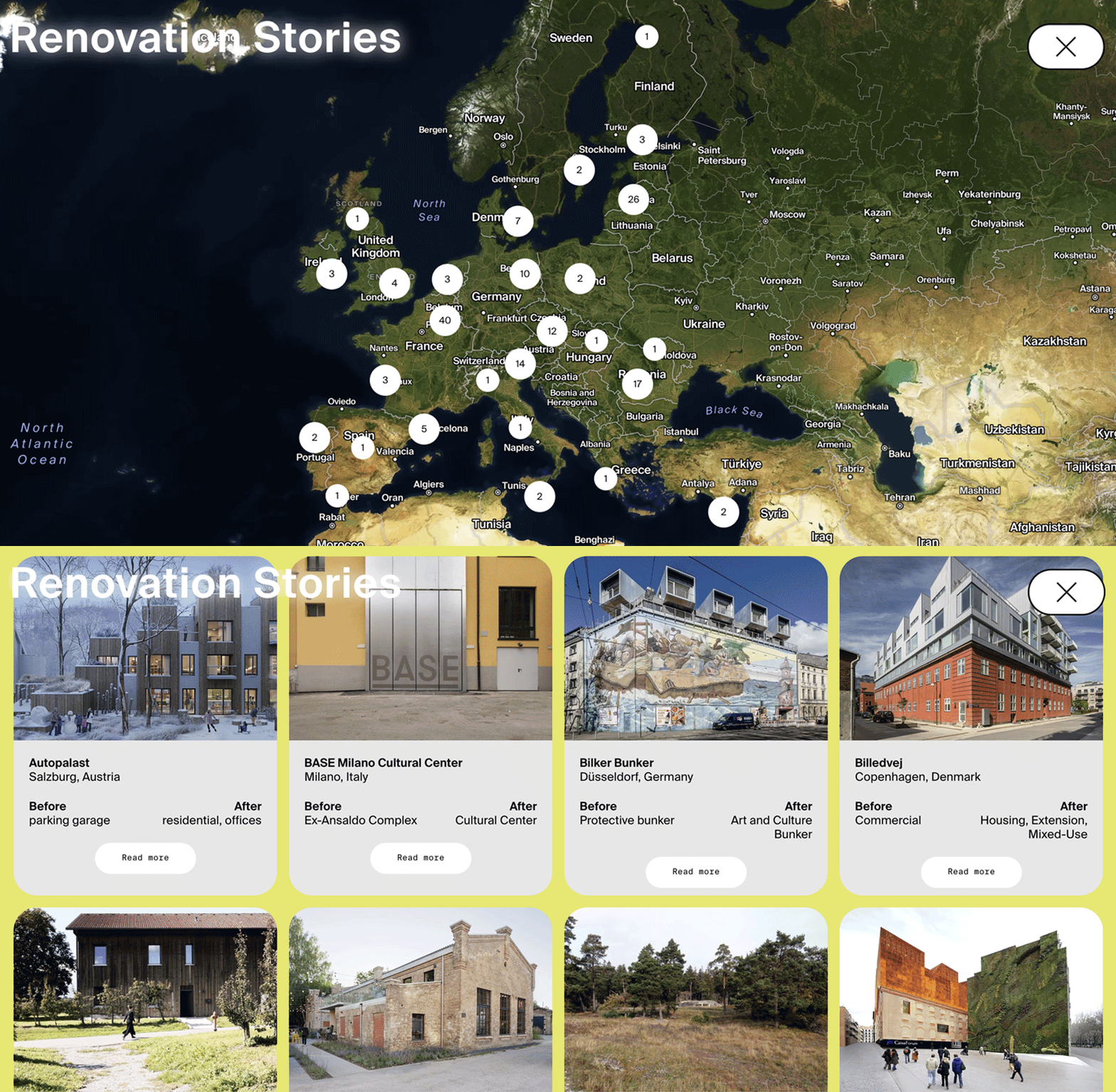
The Renovation Atlas is a growing, citizen-led platform and tool that makes renovation visible. Initiated by HouseEurope!, the Atlas brings together built examples from across Europe that show how existing buildings can be reused, adapted, and transformed instead of being demolished. It collects renovation projects as concrete evidence that social, ecological, and economic value already exists in the built environment — and that the homes of tomorrow are, in many cases, already here.
Objectives
The Atlas started as an accompanying project to the European Citizens’ Initiative Power to Renovation. Throughout the initiative, HouseEurope! repeatedly encountered the same arguments: that demolition is faster, easier, more profitable, or more sustainable than reuse. The Renovation Atlas responds to these claims with built reality. Each project is a practical counter-argument — showing that renovation is not a compromise, but a mode of development that preserves resources, stabilizes communities, and creates long-term value. Today, the Renovation Atlas includes numerous projects across Europe. The main focus in on housing, but it also features public buildings and cultural spaces. What connects them is a shared principle: they work with what already exists.
Each project is presented as a story of transformation, showing what existed before, what was changed, and what new value was created. Users can explore these stories geographically through the map or browse them visually in the gallery, discovering renovation projects across Europe from different contexts, scales, and typologies.
Goal
The Renovation Atlas is designed to grow. The long-term ambition is a comprehensive, comparable, and data-rich European map of renovation. — a map that makes social, ecological, and economic impacts legible. As of today, the Renovation Atlas is not there yet. At this stage, it functions as a best-case platform: it uses images, descriptions, and basic project information to highlight renovation as a real — viable and desirable — alternative to demolition. Nevertheless, renovation is still not the norm.
Criteria
The Atlas features submissions from individuals, initiatives, offices, municipalities, and institutions. Priority is given to projects that clearly demonstrate one or more of the following qualities:
Social value: Projects that improve living conditions without displacement, for example by maintaining or increasing the number of residents, improving comfort and accessibility, or strengthening communal life.
Ecological responsibility: Projects that extend the life of existing structures, reduce resource use, reuse materials, or demonstrably lower energy demand and emissions.
Cultural and civic value: Projects that support cultural production, preserve local heritage, create space for community use, or enable non-profit and public activities.
Economic viability: Projects that demonstrate the economic viability of reuse, renovation, and transformation — particularly in privately developed projects — showing that working with existing buildings can be financially sound and competitive over time.
As a small, non-profit, citizen-based initiative, HouseEurope! cannot document every project or verify every metric. The Atlas is based on trust and engagement. Across all categories, it values transparency, clarity of intent, and lived experience. It is an invitation to learn, to compare, and to build collective knowledge over time.
Do you know a renovation project that should be included? Are you an office, institution, foundation, or individual working on reuse and transformation? Get in touch via info@houseeurope.eu and contribute to the Renovation Atlas.
Want to help us maintain, expand, and further develop the Renovation Atlas? Support the project to raise awarness for the potential of our existing buildings and stop their demolition!